



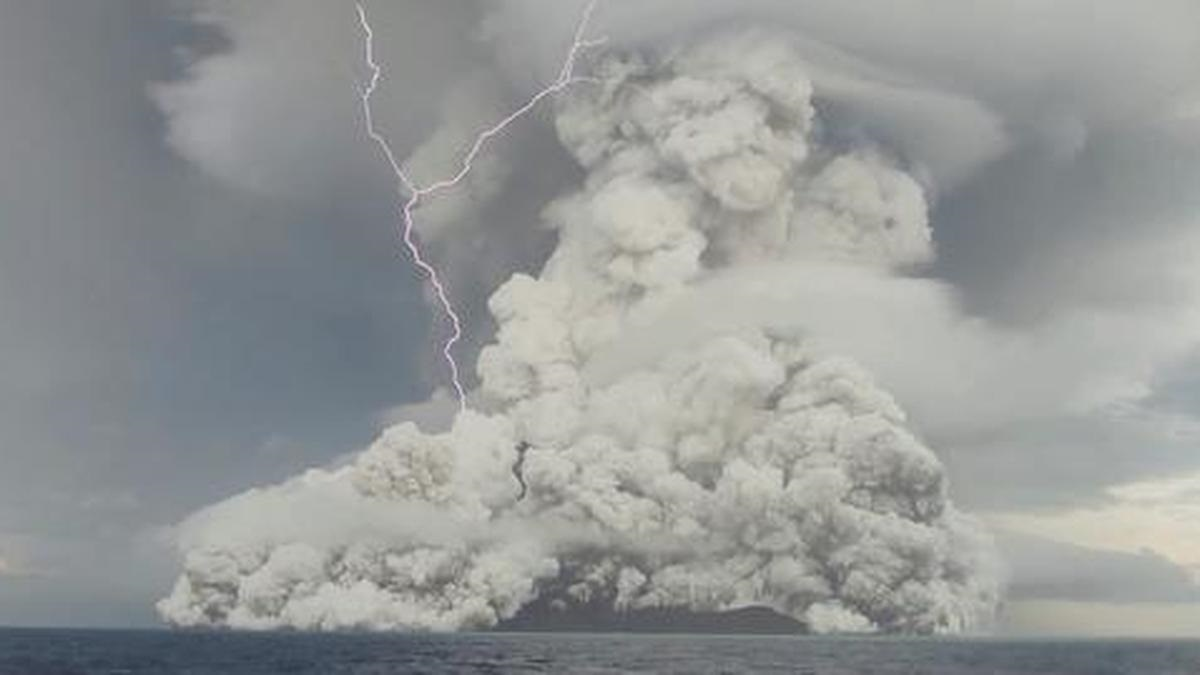
Volcanic eruptions fundamentally reshape the Earth’s atmosphere by injecting massive volumes of gases, ash, and aerosols into the troposphere and stratosphere. While these events are brief relative to geological time, their atmospheric impacts trigger global cooling, alter local weather patterns, accelerate ozone depletion, and drive long-term climate evolution.
Understanding how volcanoes interact with the atmosphere requires analyzing the chemical composition of their emissions, the altitude of injection, and the balance between greenhouse warming and aerosol cooling.
The Chemical Composition of Volcanic Emissions
Volcanoes act as direct conduits between the Earth’s interior and its outer atmosphere. When a volcano erupts, it releases a complex mixture of volatile compounds. The primary gases emitted include:
- Water Vapor (\(H_{2}O\)): The most abundant gas released, typically making up 60% to 90% of total emissions.
- Carbon Dioxide (\(CO_{2}\)): A stable greenhouse gas that can trap heat in the lower atmosphere.
- Sulfur Dioxide (\(SO_{2}\)): The most critical driver of short-term atmospheric and climate alteration.
- Halogen Gases: Hydrogen chloride (\(HCl\)) and hydrogen fluoride (\(HF\)), which present significant toxic hazards locally and impact ozone layers globally.
Dual Climatic Forces: Aerosol Cooling vs. Greenhouse Warming
The primary way volcanoes alter global climate is through a thermodynamic tug-of-war between two competing processes: solar reflection and the greenhouse effect.
                     [ Volcanic Eruption ]
                               │
       ┌───────────────────────┴───────────────────────┐
       ▼                                               ▼
[ Sulfur Dioxide (SO2) ]                       [ Carbon Dioxide (CO2) ]
       │                                               │
(Reacts with H2O vapor)                         (Traps thermal energy)
       │                                               │
       ▼                                               ▼
[ Sulfuric Acid Aerosols ]                     [ Enhanced Greenhouse Effect ]
       │                                               │
(Reflects incoming sunlight)                           │
       │                                               │
       ▼                                               ▼
  GLOBAL COOLING                                  GLOBAL WARMING
(Short-term: 1-3 years)                        (Long-term geologic scales)
1. The Power of Stratospheric Sulfate Aerosols (Cooling)
When an explosive eruption possesses enough thermal energy to punch through the troposphere, it deposits \(SO_{2}\) directly into the stratosphere (above 10-15 kilometres). In this dry, stable layer, \(SO_{2}\) reacts with available water vapor to form highly reflective droplets of sulfuric acid (\(H_{2}SO_{4}\)), known as sulfate aerosols.
These aerosols act as a planetary mirror, reflecting incoming solar radiation back into space. Because the stratosphere lacks precipitation, these particles cannot be washed out by rain. Instead, they persist for one to three years, drifting globally via high-altitude winds and causing measurable drops in surface temperatures.
Historical data compiled by the U.S. Geological Survey (USGS) highlights this mechanism in action:
- Mount Pinatubo (1991): Injected roughly 20 million tons of \(SO_{2}\) into the stratosphere, lowering global temperatures by approximately 0.5°C for over a year.
- Mount Tambora (1815): The largest eruption in recorded history blanketed the upper atmosphere in sulfur, reducing global temperatures by up to 3°C. This triggered the historic 1816 “Year Without a Summer”, which brought severe frost, crop failures, and famine across Europe and North America.
2. The Volcanic Carbon Cycle (Warming)
Volcanoes release \(CO_{2}\), a potent greenhouse gas that traps thermal energy radiating from the Earth’s surface. This has led to a common misconception that volcanic activity drives modern global warming.
Data from NASA’s Climate Change Analysis shows that global volcanic activity emits between 130 and 440 million metric tons of \(CO_{2}\) annually. In stark contrast, human industrial activities generate roughly 40 billion metric tons per year. This means humanity emits more CO2 every 2.5 to 9 hours than a massive volcanic eruption produces.
While individual modern eruptions do not cause measurable global warming, sustained, extreme volcanism over millions of years—such as the creation of Large Ignesous Provinces like the Deccan Traps—historically forced major carbon accumulations, triggering prehistoric global warming events.
Stratospheric Ozone Depletion
Beyond changing global temperatures, volcanic plumes actively degrade the stratospheric ozone layer (\(O_{3}\)), which protects Earth from harmful ultraviolet (UV) radiation.
Volcanoes do not directly destroy ozone, but they provide the chemical catalyst. The fine sulfate aerosols generated by \(SO_{2}\) present a vast surface area in the stratosphere. These surfaces host complex heterogeneous chemical reactions that convert benign, human-introduced chlorine and bromine compounds (from chlorofluorocarbons, or CFCs) into highly reactive free radicals.
Following the 1991 Pinatubo eruption, scientists at Oregon State University’s Volcano World observed a 5% to 8% drop in mid-latitude ozone levels, alongside a 33% reduction in the lower stratosphere.
Even as human CFC emissions decrease under the Montreal Protocol, modern sub-glacial or tropical eruptions continue to present localized threats to the ozone layer. For instance, researchers tracking the 2022 Hunga Tonga-Hunga Ha’apai eruption noted a 7% localized reduction in the Southern Hemisphere’s ozone layer due to the unprecedented volume of water vapor injected directly into the upper atmosphere.
Localized Weather and Air Quality Changes
Eruptions that lack the energy to reach the stratosphere still leave a severe footprint on the lower troposphere.
Volcanic Smog (“Vog”)
When sulfur dioxide is confined to the lower atmosphere, it reacts with oxygen, water vapor, and dust in the presence of sunlight to create volcanic smog, or “vog”. Vog contains tiny droplets of sulfuric acid that form a persistent, grey atmospheric haze.
This phenomenon is frequently observed downwind of effusive, long-term eruptions like those in Hawaii. It drastically lowers local air quality, limits visibility, and irritates the human respiratory tract.
Acid Rain
The interaction of tropospheric \(SO_{2}\), \(HCl\), and \(HF\) with atmospheric moisture creates highly acidic precipitation. Acid rain damages surrounding ecosystems by leaching nutrients from soils, defoliating forests, and altering the pH of freshwater lakes, which harms aquatic life.
Particulate Matter and Aviation Risks
Volcanic ash consists of pulverized rock, minerals, and volcanic glass. Unlike organic ash from wildfires, volcanic ash is highly abrasive, sharp, and non-soluble.
Large ash clouds quickly block local sunlight, causing immediate daytime darkness. When trapped in the troposphere, ash particles pose a severe threat to commercial aviation. If an aircraft flies through an active ash plume, the particulate matter melts inside the high-temperature jet turbines, coating components in liquid glass and causing total engine failure.
Atmospheric Summary
The atmospheric impact of a volcanic eruption is determined by its location, gas volume, and plume altitude.
| Atmospheric Component | Primary Volcanic Driver | Atmospheric Layer | Primary Consequence | Duration |
|---|---|---|---|---|
| Global Temperatures | Sulfur Dioxide (\(SO_{2}\)) | Stratosphere | Solar reflection and short-term global cooling | 1–3 Years |
| Ozone Layer | Sulfate Aerosols & Halogens | Stratosphere | Accelerated chemical destruction of \(O_{3}\) | 1–3 Years |
| Air Quality & Visibilty | Fine Volcanic Ash & Vog | Troposphere | Aviation hazards, respiratory health issues | Days to Weeks |
| Precipitation | Hydrogen Chloride (\(HCl\)) / \(SO_{2}\) | Troposphere | Acid rain and localized ecological damage | Days |
| Long-Term Climate | Carbon Dioxide (\(CO_{2}\)) | Global Troposphere | Geologic greenhouse gas accumulation | Millennia |
Conclusion
Volcanoes function as a natural planetary thermostat. While their massive outputs of greenhouse gases like carbon dioxide are completely overshadowed by modern human industrial emissions, their ability to generate stratospheric sulfate aerosols remains the most powerful natural driver of short-term global climate variability. By altering solar radiation transmission, shifting upper-atmosphere chemistry, and changing local precipitation dynamics, volcanic eruptions demonstrate the profound and delicate connection between the deep Earth and the air we breathe.
If you want to focus on a specific aspect of this topic, let me know if you would like to:
- Explore the exact chemical equations behind stratospheric ozone destruction.
- Review a historical case study, such as the 1815 Tambora eruption or the 1991 Pinatubo event.
- Analyze how scientists use satellite technology to track volcanic plumes in real time.
AI can make mistakes, so double-check responses
25 sites
- How Volcanoes Influence ClimateVolcanic eruptions are responsible for releasing molten rock, or lava, from deep within the Earth, forming new rock on the Earth’s…
UCAR Center for Science Education
- Volcanoes Can Affect Climate | U.S. Geological SurveyBy Volcano Hazards Program. Sources/Usage: Public Domain. Volcanic gases react with the atmosphere in various ways; the conversion…
USGS (.gov)
- How do volcanoes affect the atmosphere and climate?Another problem in Hawai’i involves the formation of vog, or volcanic fog. The ongoing eruption there is very quiet, with lava flo…
Volcano World